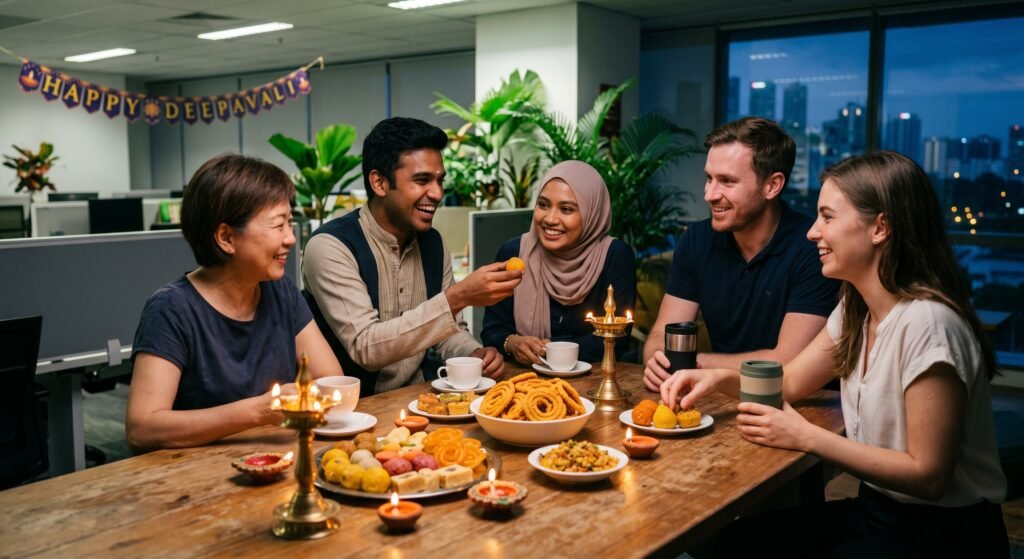
Deepavali — the festival of lights — celebrates the triumph of light over darkness, knowledge over ignorance, good over evil. Across Singapore’s Indian community and beyond, it is a time of renewed hope, of family gathering, of the deliberate illumination of what had been dark.
In a multicultural workplace, Deepavali offers more than a celebratory occasion. It offers a metaphor — and a practice — that speaks directly to the heart of what well-being at work requires: the willingness to bring light to what has been hidden, to create warmth where there has been cold, to renew rather than just continue.
What Inclusive Workplaces Actually Require
Cultural inclusion in Singapore workplaces is often addressed at the level of policy: anti-discrimination provisions, diverse hiring targets, representation in leadership. These are necessary. They are also insufficient without the warmer, more human dimension of inclusion: the daily experience of feeling genuinely welcomed, of seeing your celebrations acknowledged, of having your background treated as an asset rather than a variable to be managed.
Research on belonging and inclusion consistently shows that the most powerful inclusion indicators are not structural but relational: whether people feel known, whether their contributions are valued, whether they experience warmth rather than mere tolerance from the people around them.
The Well-Being Case for Cultural Celebration
Organisations that invest meaningfully in cultural celebrations — not performatively, but with genuine engagement and curiosity — build something that cannot be mandated: the sense that the full humanity of employees is welcomed, not just their working hours.
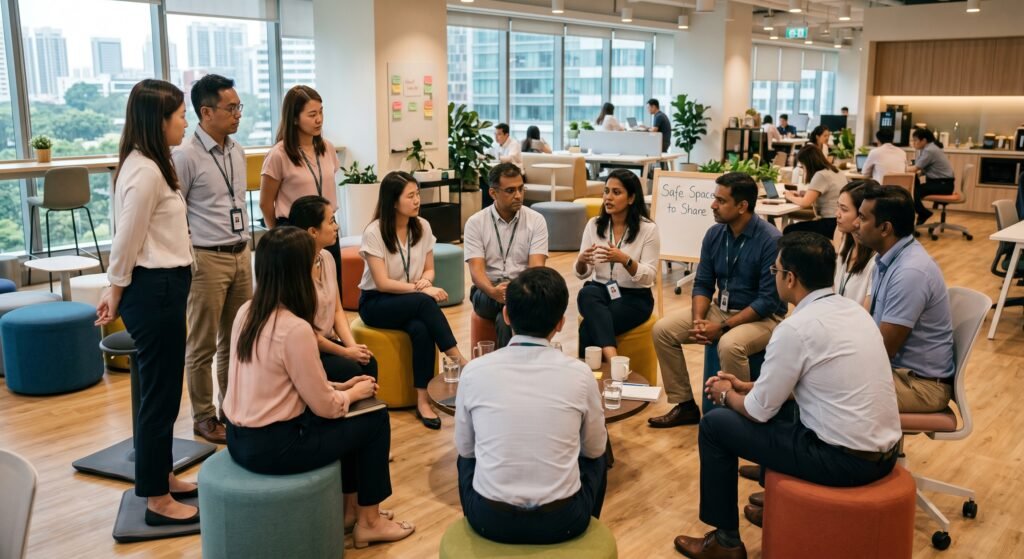
When a non-Indian colleague learns about the significance of Deepavali and asks a genuine question, when a team gathers to share sweets and the occasion is allowed to be more than a five-minute interruption, when the light of a colleague’s celebration is treated as something to be curious about — these moments build trust in a way that no policy document achieves.
Renewal as a Wellbeing Practice
The concept of renewal — central to Deepavali’s meaning — is also central to the science of wellbeing. Research by Jim Loehr and Tony Schwartz on human performance establishes that renewal is not the opposite of performance. It is its source. The capacity to return to something — a relationship, a commitment, a set of values — with fresh energy, after a period of honest reflection, is one of the most important human capacities for sustained flourishing.
Deepavali is an invitation to that renewal — for individuals, and for the organisations they are part of. What darkness have you been carrying? What light do you want to bring to your team, your workplace, your work? These are not soft questions. They are the questions that the best leaders ask at every opportunity — and that the festival of lights makes particularly vivid.