
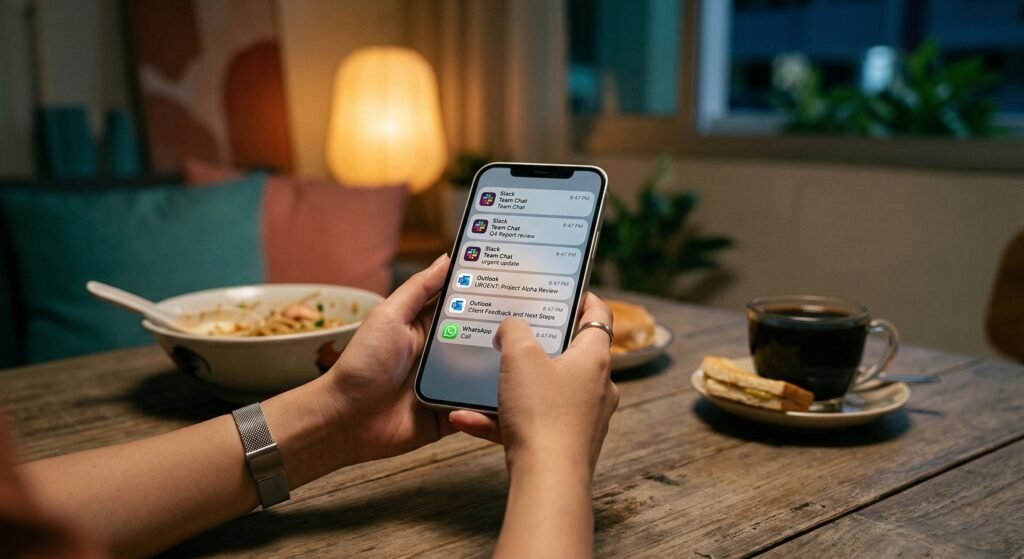
When was the last time you truly switched off from work?
Not just closed your laptop — but actually stopped thinking about emails, messages, and tomorrow’s to-do list. For many employees in Singapore, the honest answer is: they can’t remember.
The “always available” culture — where employees feel expected to respond to messages outside office hours, stay reachable on weekends, and be the first to reply in group chats — has quietly become the norm in many workplaces. A 2024 work-life balance study found that more than half of Singapore employees regularly check work messages outside office hours, with many feeling that not responding quickly could affect how they’re perceived by managers and colleagues.
The line between work and rest hasn’t just blurred. For some, it’s disappeared entirely.
Why Constant Availability Is a Well-Being Problem
Being always reachable might look like dedication, but the long-term cost is real. Over time, it can lead to:
- Chronic low-level stress — the body never fully drops out of “alert mode” when work could interrupt at any moment
- Poor sleep quality — checking messages before bed or waking up to notifications disrupts recovery
- Resentment and emotional fatigue — especially when availability feels expected rather than appreciated
- Difficulty being present with family, friends, or in personal time — because part of your mind is always “at work”
The challenge is that constant availability often doesn’t feel like a crisis. It feels normal. And that’s what makes it dangerous — by the time it shows up as burnout or disengagement, the pattern has been running for months or even years.
What Keeps the Cycle Going
Several factors make this pattern especially sticky in Singapore’s work culture:
Technology makes it effortless — when work lives on your phone, the boundary between office and home disappears. One quick reply at dinner becomes a habit that’s hard to break.
Responsiveness is rewarded — in many teams, the fastest responder is seen as the most committed. This creates unspoken pressure to stay connected, even when there’s no genuine urgency.
Fear of missing out or falling behind — in competitive environments, stepping away can feel risky. Employees worry that being offline means being overlooked.
Leaders setting the tone (often unintentionally) — when a manager sends emails at 10pm, it sends a message — even if they don’t expect a reply. Employees read the behaviour, not the intention.
What Organisations Can Do
Creating healthier boundaries around availability doesn’t mean becoming less productive. It means being smarter about when responsiveness actually matters:
- Set clear norms around after-hours communication — even a simple team agreement like “no expectation to reply after 7pm” can shift behaviour significantly
- Encourage leaders to model boundaries — when managers visibly switch off and protect their own downtime, it gives everyone permission to do the same
- Distinguish urgency from habit — not every message needs an immediate response, and teams benefit from learning to label what’s truly time-sensitive
- Celebrate recovery, not just hustle — recognising employees who manage their energy well sends a healthier signal than praising those who are always online
Small shifts in norms can have a big impact on how safe employees feel to disconnect.
How Peers and Well-Being Champions Can Help
You can play a meaningful role here, even without formal authority:
- Avoid sending non-urgent messages late at night — or if you do, use a scheduled send so it arrives during working hours
- Gently call out “always on” culture when you see it normalised — “We don’t need to respond to this tonight” is a powerful sentence
- Check in with colleagues who seem tethered to their phones — they may not even realise how much it’s affecting them
Sometimes the most supportive thing a peer can do is model what healthy boundaries look like in practice.
The Bigger Picture
Rest isn’t a reward for finishing everything. It’s what makes sustainable performance possible in the first place.
Organisations that protect their employees’ right to disconnect aren’t being soft — they’re being strategic. Because a workforce that can truly recover is a workforce that can truly perform.
And well-being starts the moment someone feels safe enough to put their phone down.