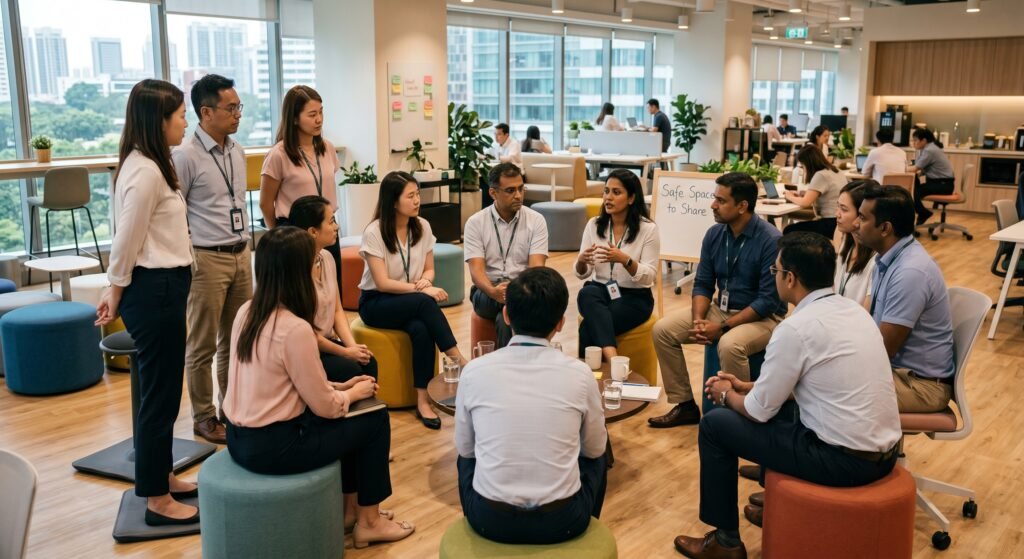

Mental health awareness in Singapore has grown steadily over the past decade. Conversations about stress, burnout, and well-being are more visible than ever, both in workplaces and in public discourse. Yet many employees still hesitate to seek help or speak openly about their mental health.
This gap between awareness and action raises an important question: what does meaningful workplace mental health support actually look like in practice?
Awareness Is a Starting Point, Not the Goal
Public education efforts have improved mental health literacy across Singapore. Studies by IMH indicate increased recognition of common mental health conditions and greater understanding of where to seek help.
However, awareness alone does not automatically translate into safer or more supportive workplaces. Employees may know that support exists, but still fear judgement, career consequences, or being perceived as less capable. As a result, many continue working while distressed, a phenomenon known as presenteeism, which affects both well-being and productivity.
What Employees Need to Feel Supported
Workplace mental health support is most effective when it is practical, visible, and trusted. Employees are more likely to seek help when:
- Expectations around workload and performance are realistic
- Managers are approachable and trained to respond supportively
- Policies are applied consistently, not selectively
- Support options are clearly communicated and easy to access
Importantly, support does not always mean formal intervention. Often, early conversations and timely adjustments can prevent issues from escalating.
The Importance of Everyday Responses
Many moments that shape mental well-being happen in everyday interactions — a manager noticing a change in behaviour, a colleague checking in, or a team leader responding empathetically to a request for flexibility.
This is where foundational skills such as Psychological First Aid become valuable. PFA focuses on recognising distress, listening without trying to “fix” the problem, and connecting people to appropriate support. These skills are particularly useful in non-clinical settings like workplaces, where early response can make a meaningful difference.
Moving Beyond One-Off Initiatives
Well-intentioned initiatives such as mental health talks or awareness days can help start conversations, but they are most effective when embedded within a broader system of support.
Sustainable workplace mental health efforts often include:
- Ongoing manager capability-building
- Peer support or well-being champion networks
- Clear escalation pathways for employees in distress
- Opportunities for employees to learn and reflect together
In Singapore, Communities of Practice focused on well-being provide a space for organisations and individuals to share insights, challenges, and practical approaches grounded in local contexts.
Creating Conditions for Action
For employees to move from awareness to action, they must feel psychologically safe. This means knowing that speaking up will lead to support, not negative consequences.
Organisations that succeed in this area are those that consistently reinforce the message — through words and actions — that mental well-being is part of doing good work, not something separate from it.